Preposterously Luscious: Designing characters for Mandrake
Chris Gardiner - Failbetter's Narrative Director and lead writer on Mandrake - and senior artist Erion Makuo talk about their character design process.
Chris: Erion Makuo, we meet again.
Erion: Chris Gardiner, my friend in arms!
Chris: Last time we talked, we discussed your work on the interiors of our characters’ homes. This time I want to talk about your preposterously luscious character designs, and I should warn you I’m going to be embarrassingly gushy about them.
Erion: Oh no.
Chris: They’re just so thick with detail and personality. See, dear reader:

Hob Halfling
Chris: For goodness’ sake. Look at it.
For context: these are the illustrations that appear next to the dialogue window when you're talking to an NPC. Ok, let’s talk about your process first, then dig into some examples.
I suppose we start with a written character profile, written by either myself or George Lockett, our other Mandrake writer. It feels to me like you study those profiles very closely?
Erion: I try to! I’m looking for anything that will be directly pertinent to the illustration, of course, but it’s always useful to know the character’s full background, and which parts of it could be used as features in the art.
Chris: I ask that because it always feels to me like you somehow know these characters better than I do, even when I came up with them. And the more we’ve worked together, the less specific guidance I’ve ended up putting into the art notes in the profile, and the more work I’ve put into their history and personality notes. Because you’ll always come up with some detail about them that is absolutely perfect, but I never could have come up with.
Erion: Sometimes those details are prompted by the constraints of the illustration – the way colours might work together, or the space we need to fill. But I always try to make them say something about the character.
After I’ve read the profile, I do concepting: I come up with a simple pose for the character, then dress them up in different ways. Usually about half a dozen or so? Their clothes often say a lot about what they do in the village, their social station, how they live, and who they are.
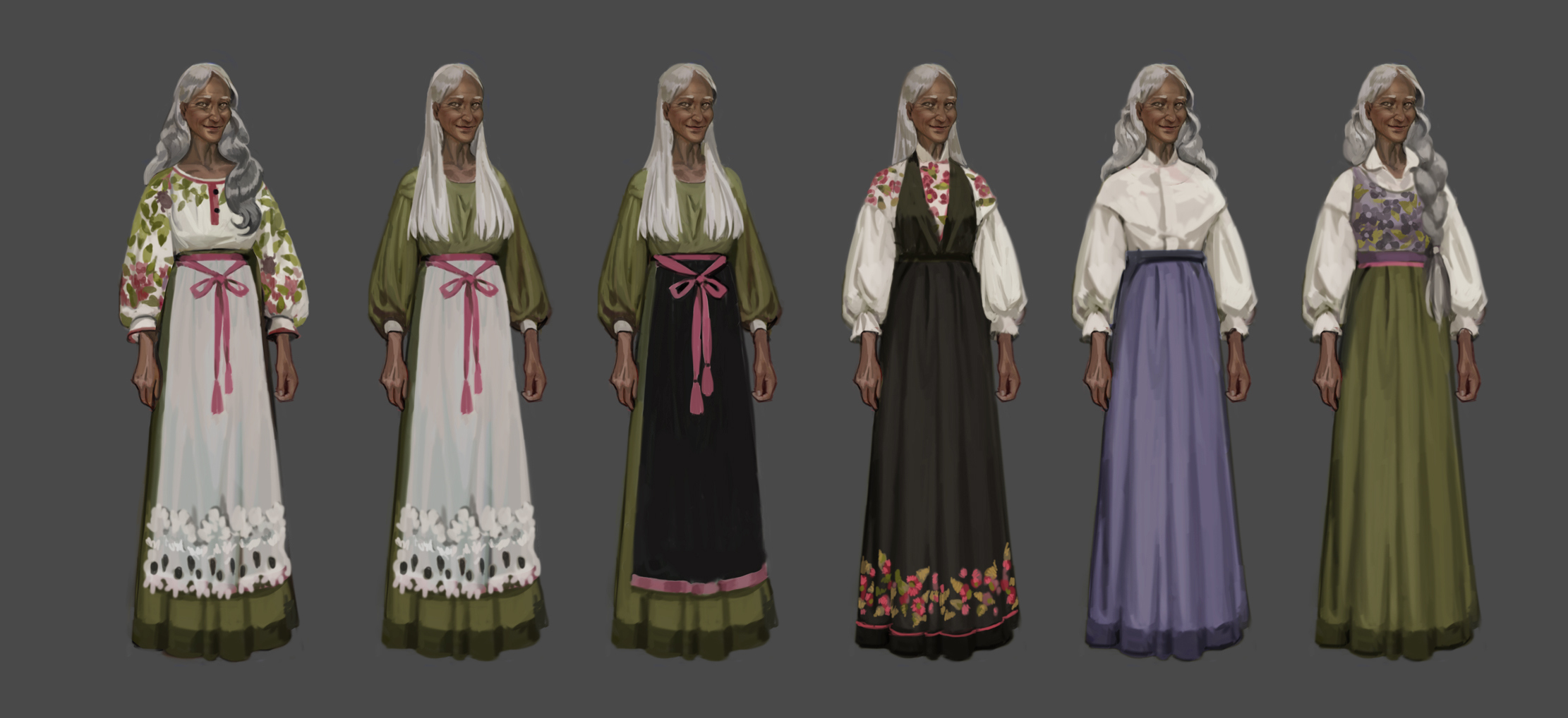
Choosing an outfit for Metheven Ivey
Erion: A group of us then discuss which ones work best for the character, and how they fit with the game’s setting. After that, I work up a couple of sketches for the character’s pose in the illustration.
Chris: The poses have become a big part of the portraits, I think. You put so much personality into them.
Erion: They’re also a good way to show what the character does all day – we can show them working at a spinning wheel, or walking the moors. I just have to be careful not to make them seem too engrossed in what they’re doing, or it looks like they don’t want to talk to the player!
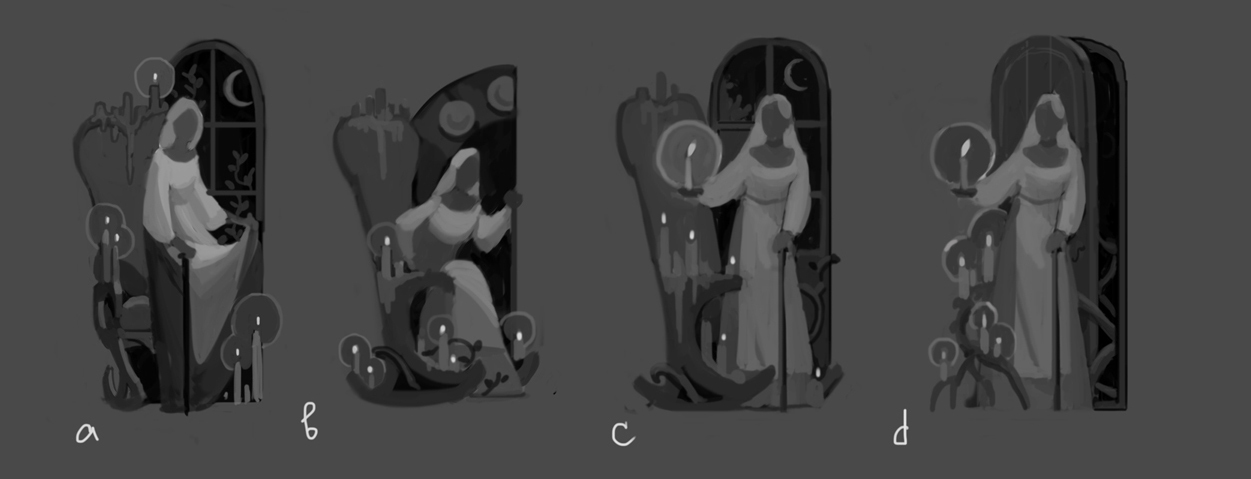
Choosing a pose for Metheven Ivey
Erion: After a pose is agreed, you and I often talk about the symbolism we might use in the image, and then I move to the full illustration.
Chris: I’ve said this to you before, but when I see the final illustration, I always find it easier to write the character. You always capture something about them I haven’t been able to put into words, and it’s like meeting them for the first time.
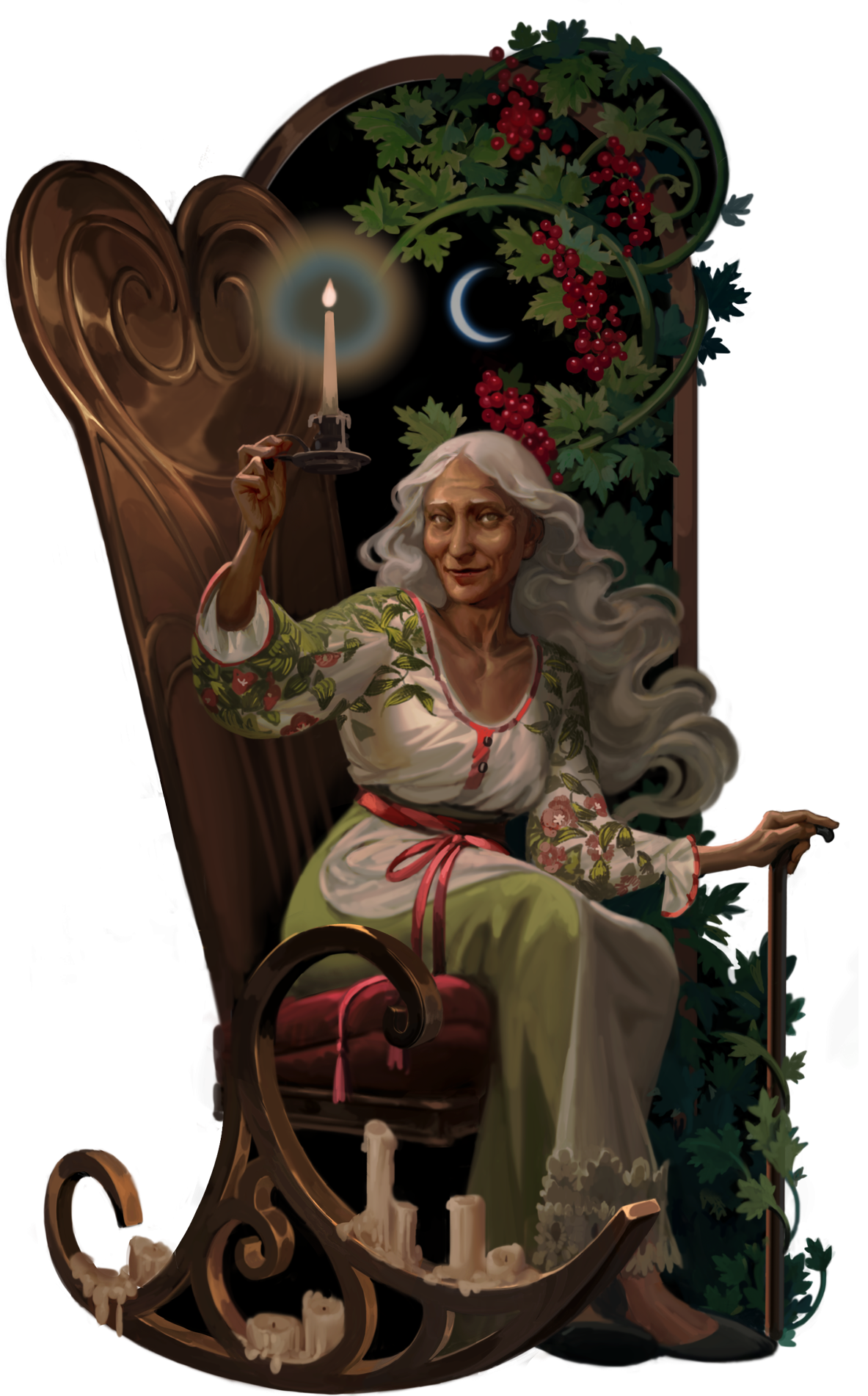
Chris: Let’s talk about the visual approach you’ve settled on – because in addition to the character, you include other elements in the image: some of them practical, like a tool or environment, and some of them symbolic.
Erion: We came to this approach gradually. Early on, I drew Gideon in a pose where he was sitting cross-legged, and we liked it, but it looked like he was levitating. So I added a tree that he was sitting in—
Chris: And that looked great.
Erion: —so we started doing it more and more, and adding other details that communicated something about the character, like Kenway's herd or Thackery’s machines.
Chris: We started talking about the illustrations a bit like tarot cards, where the details suggest a bigger story. And I love that we can include details that just seem like decoration at first, but as the player gets to know the character more, those details are revealed to be clues to their past, or a secret they keep.
Shall we talk about some examples? Here’s Thackery:
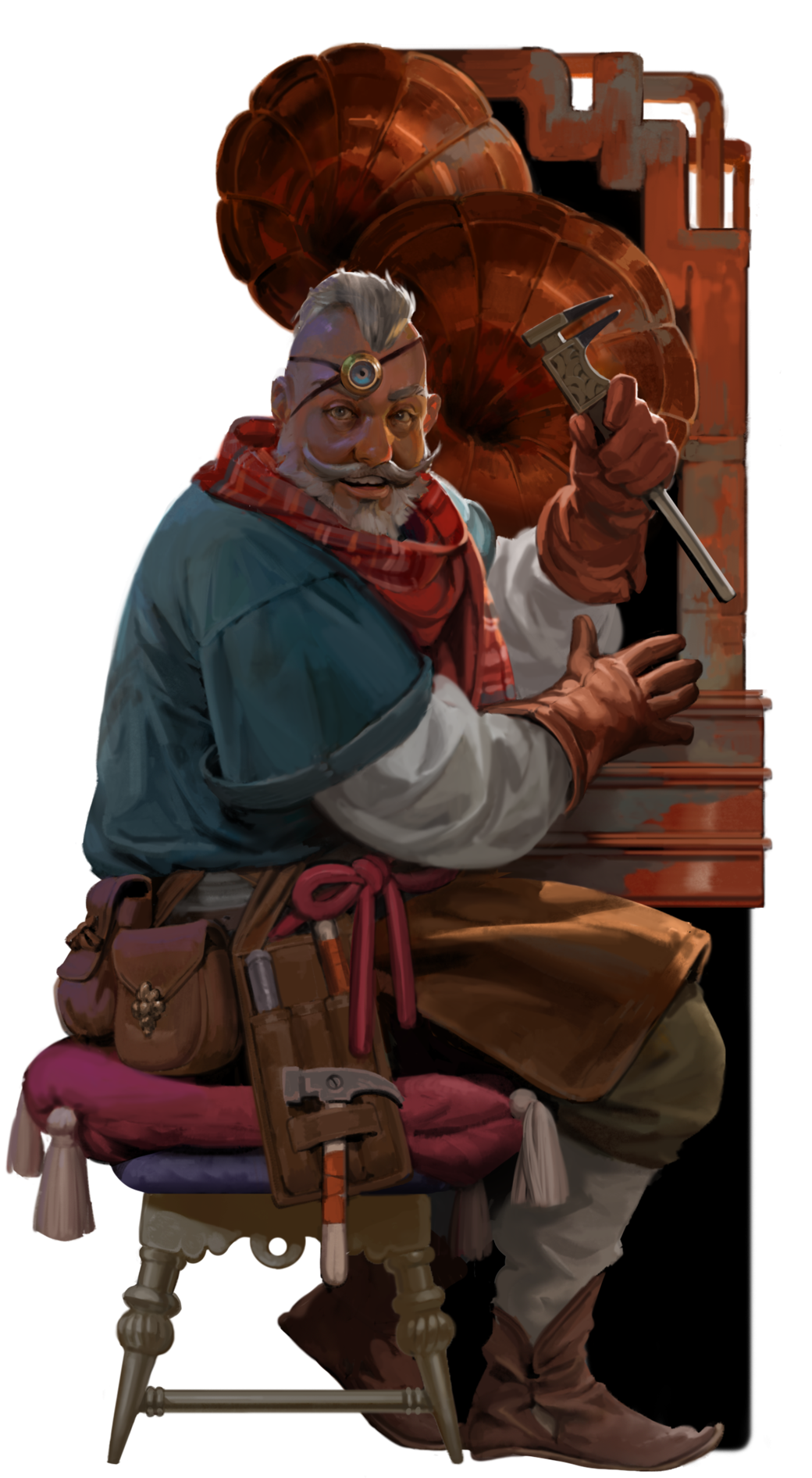
Thackery belongs to an order called the Voicers, who keep the last vestiges of a technology called chorophony, which is kind of like radio.
Erion: Lead Artist Toby Cook had already done the initial design for Thackery, so his appearance and clothing were already established – the eye-piece, the stole (which is a symbol of his faith), the tool-belt…
In this illustration I gave him his sitting pose, as if he was working, and added the machinery in the background. That’s his chorophon. Because it’s not something you might expect in a fantasy setting, we wanted to make it a prominent feature when you spoke to him.
Also, you’ll notice I added tassels to his cushion.
Chris: All hail the queen of tassels.
Erion: One small story: after I drew this illustration I ended up flipping it, and a couple of others – because we realised that these illustrations appear to the left of the dialogue bar, so the composition needs to lead the eye to the right. What’s more, the dialogue choices the player will spend their time considering will be down at the bottom-right. That means the player’s eyes will spend most of their time down there. This means that whatever we draw in the bottom right of these illustrations has to be really good.
Chris: You can do what you like in the top-left, though. Top-left is the party zone.
Erion: Yeah, top-left: pfft, whatever.
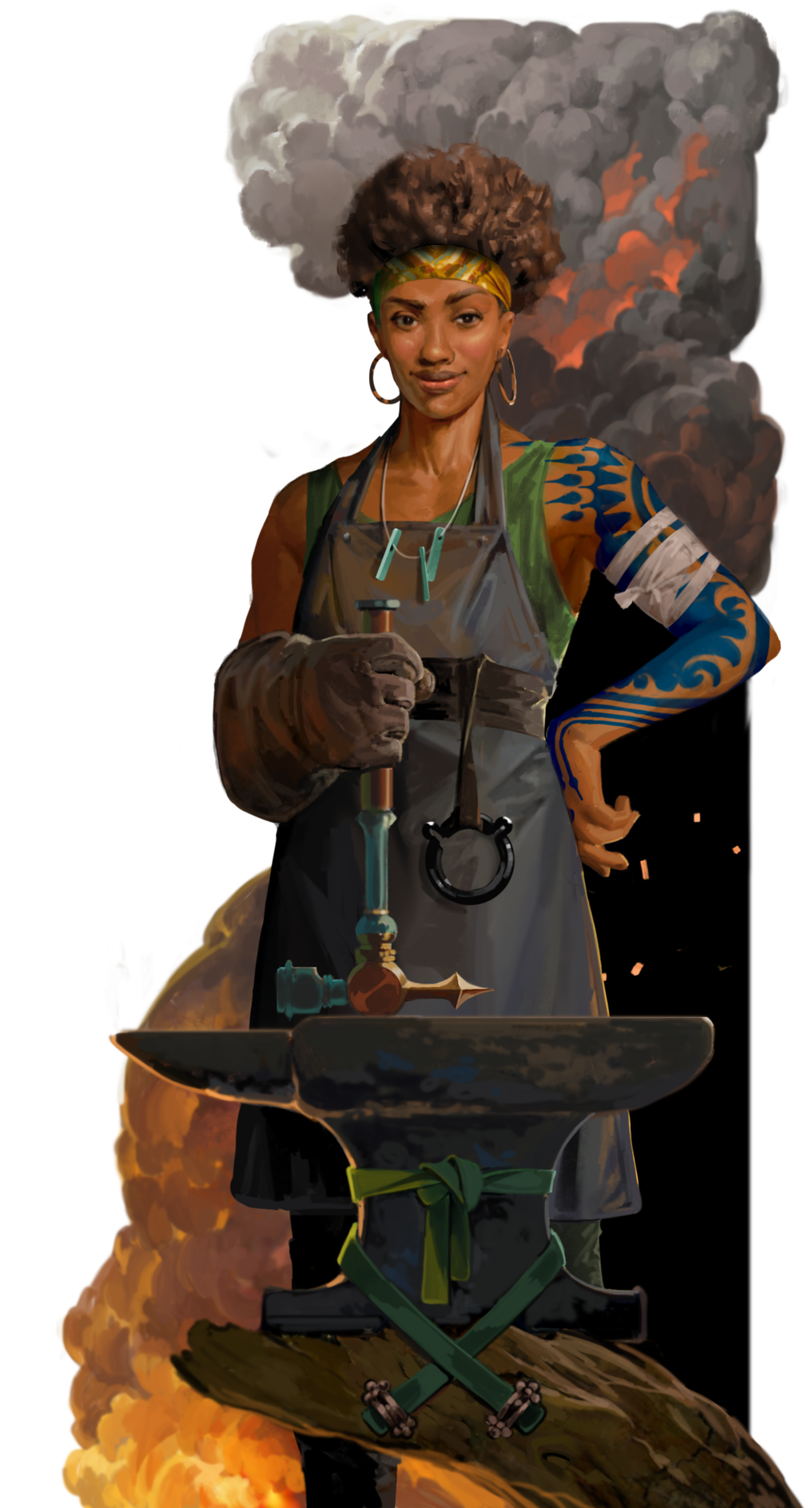
Nessa Thretheway
Chris: Let’s talk about Nessa next. Nessa’s our smith, and smiths were sometimes seen as semi-magical. Nessa’s the first person you meet in the village, but she has a secret or two.
Erion: This was another character that Toby had done the initial design for. My big changes were the tattoos, which I made blue and redesigned, and adding her tools: the anvil and the hammer. The hammer is meant to be an old one, made of the same materials that our fallen civilisation, the Sophoi, used.
Chris: I love that anvil – the fact it’s mounted on a root is such a fantastic image. It suggests there’s more at play here than mundane smithing — a sense, perhaps, that her work is rooted to the earth in some way.
Also, I think this is the first illustration that added something entirely new to our lore. In this case, it’s the fact that Nessa’s tattoos are specifically on her left arm – that looked so cool that we incorporated it into her story, but I can’t say how because it’s a big spoiler.
Erion: Booooo.
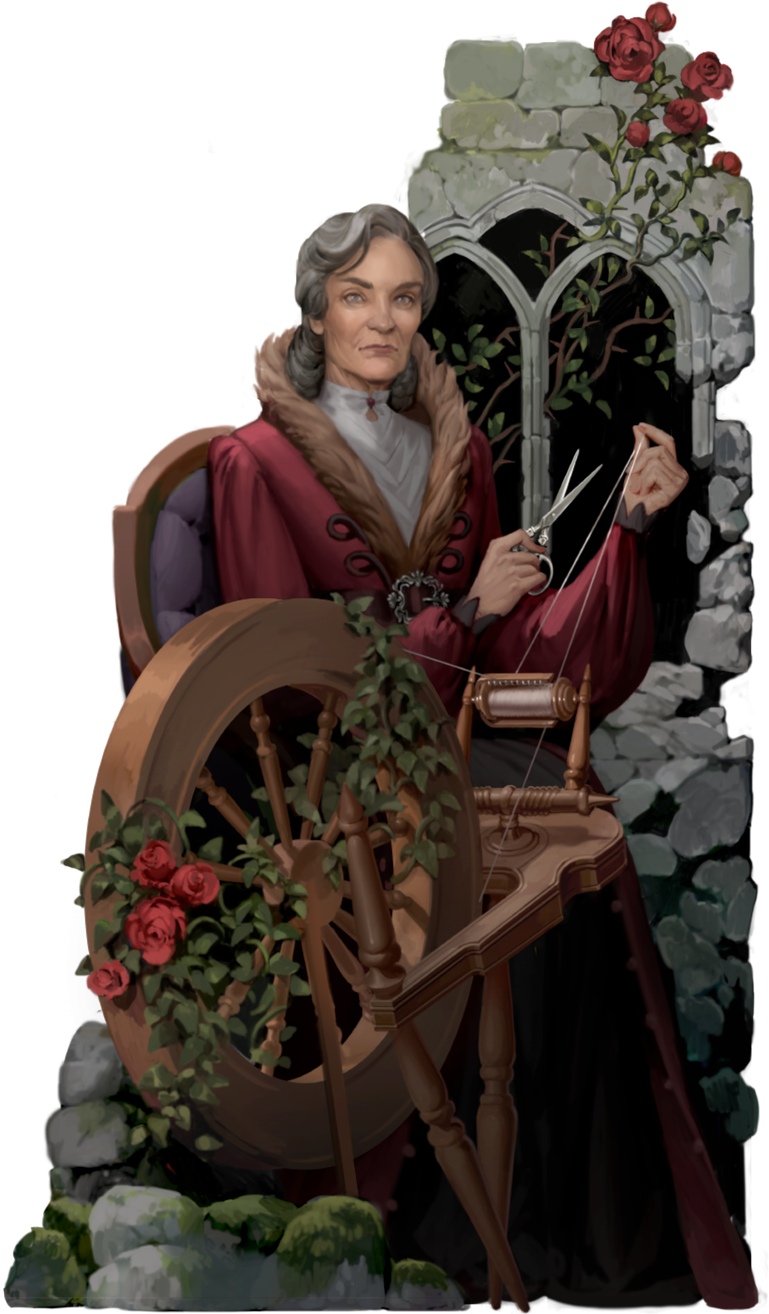
Eseld Isble
Erion: This is Eseld. She’s the matriarch of one of the two major families in the village, and a seamstress. My favourite part of this one is the roses. They’re an old emblem of her family history, which she takes a lot of pride in, so I wanted them to feature in her art.
Chris: Yes, we’ve tied roses to a very specific bit of the lore: a rival house to the Mandrakes. And Eseld is connected to that — which affects how she sees the player character, of course.
Erion: The spinning wheel was such a pain! It’s a big part of her role, and who she is. And at our level of zoom in gameplay we won’t be able to see her working at it close-up, so I wanted to feature it here. But it’s a complex geometric shape, it has to be exactly right, and it was really hard.
I also like her pose – the gesture she’s making with the thread and the scissors. It feels powerful, fitting her role as matriarch of the family. It recalls the Fates, and cutting the life-threads of mortals – which isn’t a direct inspiration, but again speaks to that sense of power.
Chris: Let’s do Josselin next.
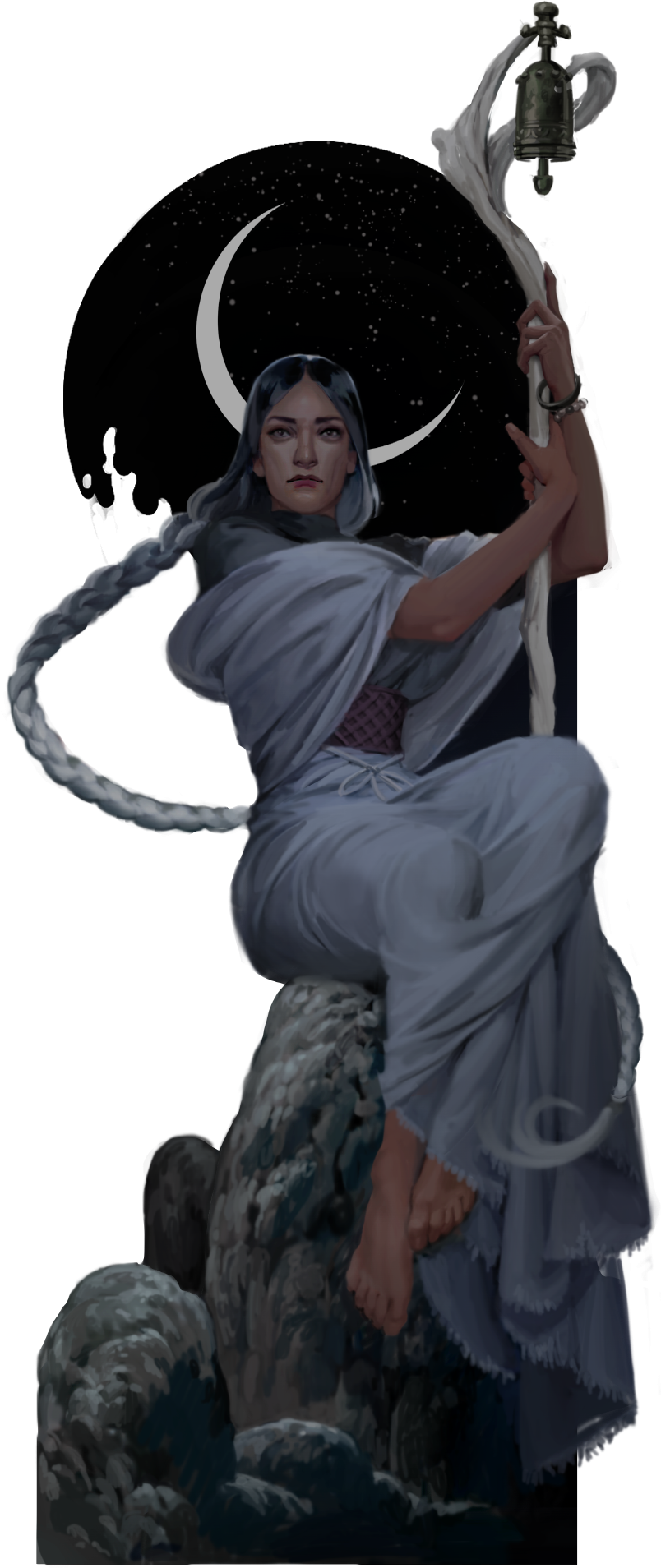
Josselin Legge
Chris: I love Josselin. Is she my favourite character? Maybe. But this is an illustration that just blew me away, because it turned out completely differently than I imagined, but drastically better in every way. I understood her so much better after seeing this.
Erion: Josselin lives alone and simply in the forest, so her dress reflects that – it’s basically a single long piece of cloth, wound about her and cinched at the waist. And the hem is frayed and tattered from wear – she probably doesn’t have the tools to mend it properly, and because she’s an outsider she can’t go to Eseld to fix it.
Chris: Yes, she lives away from the village, and has a more mystical background. The moon is a very important part of her story, hence its presence in the background, and I love how you’ve drawn it – that single simple sliver of white. I love her staff and its bell, too. There’s so much specific lore in this image, which will all pay off when people play the game.
Especially the hair, which was entirely your idea, and is outright genius.
Erion: If you look carefully at it, you can see that her silver hair is growing out – her newer hair is black. So it’s not aging – something very specific is happening. Which you also probably won’t let me talk about.
Chris: You are tragically correct. I am the spoiler police, today.
Erion: But that was another decision that actually originated in a visual constraint — I realised I was going to be painting black hair meeting a black shirt, and was worried about the lack of contrast. So I wondered if we could divide her hair colour in two shades, and came up with this idea that fit her story perfectly.
Chris: You know things about Josselin that I’ve only told one other person: George, my co-writer. Because it’s stuff that a writer needs to know to get her right, but that if talked about more widely among the team or externally might distract or complicate. Details we want to be implicit in the writing, not explicit. But I told you because I figure you need to know everything I do in order to illustrate her.
Erion: I’m also very pleased with the rocks.
Chris: Those are great rocks! We should call it there or we’ll start talking excitedly about rocks. Inevitably we’ll end up talking in another blog post at some point – I just want to ask you questions about everything you’ve done. But let’s stop here for now. Farewell, art-comrade.
Erion: Godspeed, comrade-at-words.